$16,188 / year — U.S. list price of Wegovy (semaglutide) at $1,349/month; estimated net cost after rebates ≈ $6,829/year (semaglutide) and $7,973/year (tirzepatide).¹ ²
For employers & partners // 01
BRING THE CHALLENGE TO YOUR PEOPLE.
A turnkey 12-week strength and longevity program for your people — a clinician layer plus real, progressive strength training, prescribed daily by HI//TRAINING and adjusted to each person's readiness.
Download the employer one-pager (PDF)
Scheduling link pending. To arrange an intro now, email hello@getyourflo.app.
- 12 weeks· One defined cohort
- Per-participant pricing· One invoice
- Aggregate-only reporting· No individual health data
The problem // 02
THE MATH EMPLOYERS ARE FACING.
18% — of firms with 200+ workers cover GLP-1s for weight loss in their largest health plan. 65% do not.³
25–40% — of the weight lost in the pivotal GLP-1 trials' body-composition substudies was lean mass (≈38–40% semaglutide; ≈26% tirzepatide).⁴ ⁵
16% — higher all-cause mortality risk per 5 kg lower grip strength; muscle-strengthening activity is associated with a 10–17% lower mortality risk.⁶ ⁷
Medication decisions belong to employees and their clinicians. Muscle is the part nobody is managing — until now.
A 100-PERSON COHORT COSTS LESS THAN ONE YEAR OF GLP-1 MEDICATION — AT NET COST — FOR THREE EMPLOYEES.1, 2
Sources
- Peterson-KFF Health System Tracker, "How do prices of drugs for weight loss in the U.S. compare to peer nations' prices?", Aug 2023 (list prices).
- Institute for Clinical and Economic Review, Final Evidence Report: Treatments for Obesity, 2025 (net prices, SSR Health data).
- KFF, 2026 Employer Health Benefits Survey, Oct 2026 (firms with 200+ workers offering health benefits; largest-enrollment plan).
- Wilding et al., J Endocr Soc 2021 (STEP 1 DXA substudy); Mozaffarian et al., joint clinical advisory, 2025.
- Look et al., Diabetes Obes Metab 2025 (SURMOUNT-1 DXA substudy).
- Leong et al. (PURE), The Lancet 2015.
- Momma et al., Br J Sports Med 2022.
Why strength, why now // 03
THE INTERVENTION IS LOAD.
01 // Infrastructure
MUSCLE IS NOT AN EXTRA.
Muscle is metabolic infrastructure: it contributes to glucose disposal, everyday function and the physical capacity involved in maintaining weight loss. Strength also matters to mobility and the ability to manage demands associated with falls and fractures. That makes training a practical part of a longevity program, not just an education topic.
02 // The missing work
WEIGHT IS NOT THE WHOLE STORY.
Weight loss through dieting or medication can include lean mass as well as fat. Lean mass is not the same as muscle alone, and a change on the scale does not show whether strength is progressing. Resistance training puts muscle and function on the program's agenda without making medication decisions for anyone.
03 // The training dose
PROGRESS, NOT JUST ADVICE.
The muscle-building component is progressive resistance training: repeated movements, sufficient effort and a load or repetition target that advances over time. Foundational lifts stay consistent long enough to measure progress. Education about exercise does not substitute for doing that work, and no individual result is guaranteed.
Program architecture // 04
ONE PROGRAM. THREE DOORS IN.
Every cohort runs the same 12-week system — a clinician layer (baseline and follow-up testing with licensed clinician review) combined with daily, progressive strength training prescribed by HI//TRAINING. Sponsors choose the framing that matches their population.
Door 01
THE ALTERNATIVE
For organizations that do not cover GLP-1 medications. A complete metabolic health program — testing, clinician review, and structured strength training — at a per-participant cost instead of a per-prescription cost.
- Who it's for
- Employers who have decided against GLP-1 coverage and need a credible offer for employees asking for metabolic support.
- How it runs
- The sponsor launches one code-enrolled cohort. Participants complete baseline testing with licensed clinician review, follow readiness-adjusted training for 12 weeks and receive follow-up testing and a personal close-out summary. This is a training offer, not a substitute for clinically indicated treatment.
Door 02
THE COMPANION
For employees using GLP-1 medications obtained elsewhere — through another plan, a telehealth provider, or out of pocket. Structured strength training and protein guidance support the goal of preserving muscle and function alongside their existing care.
- Who it's for
- Employers whose people are already using these medications, whether or not the employer's plan pays for them.
- How it runs
- Participants enter the same baseline, daily-training and close-out pathway. Training effort follows readiness, and loads progress by rule as the participant earns the next step. Medication prescribing, dosing and treatment questions remain with the participant and their own clinician.
Door 03
THE OFF-RAMP
For people transitioning off GLP-1 medication. Strength, protein, and progression structure for the months when weight regain risk is highest.
- Who it's for
- Employers and plans managing discontinuation, coverage limits or step-downs.
- How it runs
- The cohort supplies a defined training rhythm, licensed clinician review at baseline and follow-up, and measurable strength progression. Any decision to stop or change medication is made outside the training program with the participant's clinician. The program does not promise prevention of weight regain.
What's included // 05
EVERYTHING IN THE 12 WEEKS.
The participant gets a daily plan and a personal close. The sponsor gets the materials to launch and the aggregates to evaluate the cohort.
THE PARTICIPANT RECEIVES
- HI//TRAINING access for the full cohort. The daily readiness directive and prescribed sessions on dumbbell or bodyweight tracks, with exercises, sets, repetitions and target effort specified.
- Baseline testing with licensed clinician review. Testing and results review happen through the clinician layer, directly with the participant.
- Follow-up testing at close. Licensed clinician review provides the participant's clinical discussion at the end of the pathway.
- A personal baseline and close-out summary. Their own results, strength progression and protocol adherence — for them, not their employer.
- A sponsor-issued enrollment code and onboarding support. A clear route into the cohort without needing a studio or gym membership.
- Communications throughout the 12 weeks. Launch instructions, the weekly rhythm, a midpoint touchpoint and close-out guidance keep the pathway understandable.
THE SPONSOR RECEIVES
- Cohort sizing and launch planning. Agree the audience, contracted seats, cohort start date and success metrics before launch.
- A ready-to-distribute launch kit. Announcement email copy, intranet and benefits-portal copy, manager talking points, and a digital poster with an enrollment QR code.
- Enrollment code administration. We administer the cohort codes; the sponsor distributes the invitation through its normal benefits channels.
- A midpoint participation update. At week 6, an aggregate view of enrollment, active participants and sessions completed.
- A full aggregate outcomes report at close. Participation, completion, logged workouts, foundational strength progression, aggregate baseline-to-close-out measures and cohort satisfaction.
- A close-out review call. Walk through the report together, revisit the agreed metrics and consider next-cohort or continuity options without an automatic commitment.
What is not included
HI//TRAINING does not prescribe medication, does not replace an employee's own clinician, and is not a condition-management or disease-treatment program. Clinical services are provided by licensed clinicians through HIPAA-covered clinical partners.
Inside the program // 06
LESSONS VS. LOAD.
The difference is in what happens after the employee opens the app. Information is useful; a prescribed session adds a specific training dose and a rule for what comes next.
| Coaching programs | HI//TRAINING |
|---|---|
| Lessons and articles | A prescribed training session every day |
| Coach messages and check-ins | Exercises, sets, reps and target effort specified |
| Habit and nutrition education | Actual loads that progress week to week by rule — double progression |
| Self-reported activity | Readiness-adjusted intensity — Recovery, Normal or Push — from wearable signals, with manual check-ins when needed |
Education tells people exercise matters. Programming makes it happen, at a dose that works.
A pathway, not a shuffled playlist
12 WEEKS OF STRUCTURE.
Weeks 1–4
FOUNDATION
Establish movement quality, select the dumbbell or bodyweight track and set baseline loads. Complete baseline testing and licensed clinician review. Learn how the rep range and target effort guide each session before adding weight.
Weeks 5–8
BUILD
Progress stable lifts by double progression: reach the top of the prescribed rep range at the target effort, then increase load and return to the lower end. Volume increases through the programmed block; readiness can reduce or increase the day's effort. The sponsor receives the week-6 aggregate update.
Weeks 9–12
CONSOLIDATION
Continue the planned progression rather than chase an arbitrary load. Consolidate the block's work, complete close-out testing with licensed clinician review and receive the personal summary. Peak progression is relative to the participant's pathway, not a requirement to lift maximally.
ILLUSTRATIVE — example loads, not participant results or targets
THE SAME LIFTS. A NEXT STEP.
Example sessions from weeks 1, 6 and 12 for one fictional dumbbell-track participant. Loads are in pounds (lb); paired-dumbbell loads are shown per hand and in total. Each example uses 3 working sets of 8 reps, stopping with approximately 2 good reps in reserve; the full progression uses an 8–12 rep range. The numbers show external load only, not total session volume.
| Exercise | Week 1 | Week 6 | Week 12 | W1 → W12 load change |
|---|---|---|---|---|
| Goblet squat One dumbbell | 20 lb total 3 × 8 reps | 22 lb total 3 × 8 reps | 24 lb total 3 × 8 reps | +4 lb / +20.0% |
| Dumbbell Romanian deadlift Two dumbbells | 15 lb each 30 lb total · 3 × 8 | 16 lb each 32 lb total · 3 × 8 | 17 lb each 34 lb total · 3 × 8 | +4 lb total / +13.3% |
| Dumbbell bench press Two dumbbells | 10 lb each 20 lb total · 3 × 8 | 11 lb each 22 lb total · 3 × 8 | 12 lb each 24 lb total · 3 × 8 | +4 lb total / +20.0% |
These examples assume adjustable dumbbells with the illustrated increments. A participant earns an increase only after completing all prescribed sets at the top of the rep range with the intended effort and sound technique. With different equipment, the next step may be repetitions rather than weight. There is no requirement to match these loads, and Recovery days can call for reduced work.
One Morning
SIGNALS → A CALL → THE WORK → THE NEXT STEP.
Wearable signals overnight
With permission, overnight wearable signals contribute readiness context alongside recent training. Sleep, recovery and the participant's morning check-in inform the day's decision; manual check-ins are available without a wearable.
Readiness and today's call
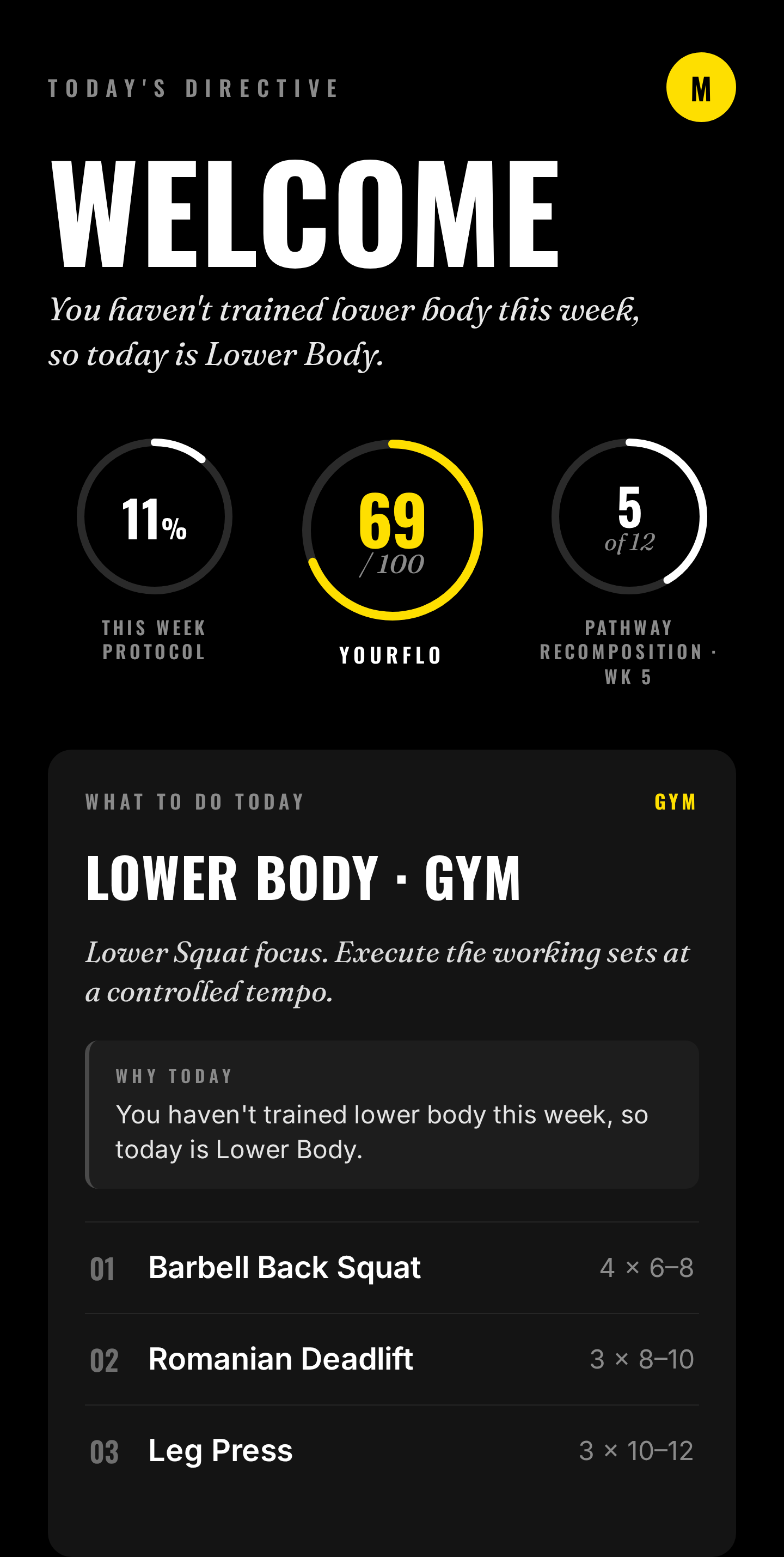
Open Today to see the daily directive — Recovery, Normal or Push — and the reason for the call. The Today screen gives you the reason for the call and the prescribed work. The directive is not a diagnosis or a reason to change medication.
The exact prescribed session
Follow the exercises, sets, reps and target effort for the selected track. On a Normal day, a session can use the prescribed working rep range; on a Recovery day, the directive can reduce the demand. The prescription tells the participant what to do, not simply that exercise is useful.
Log the work; inform progression
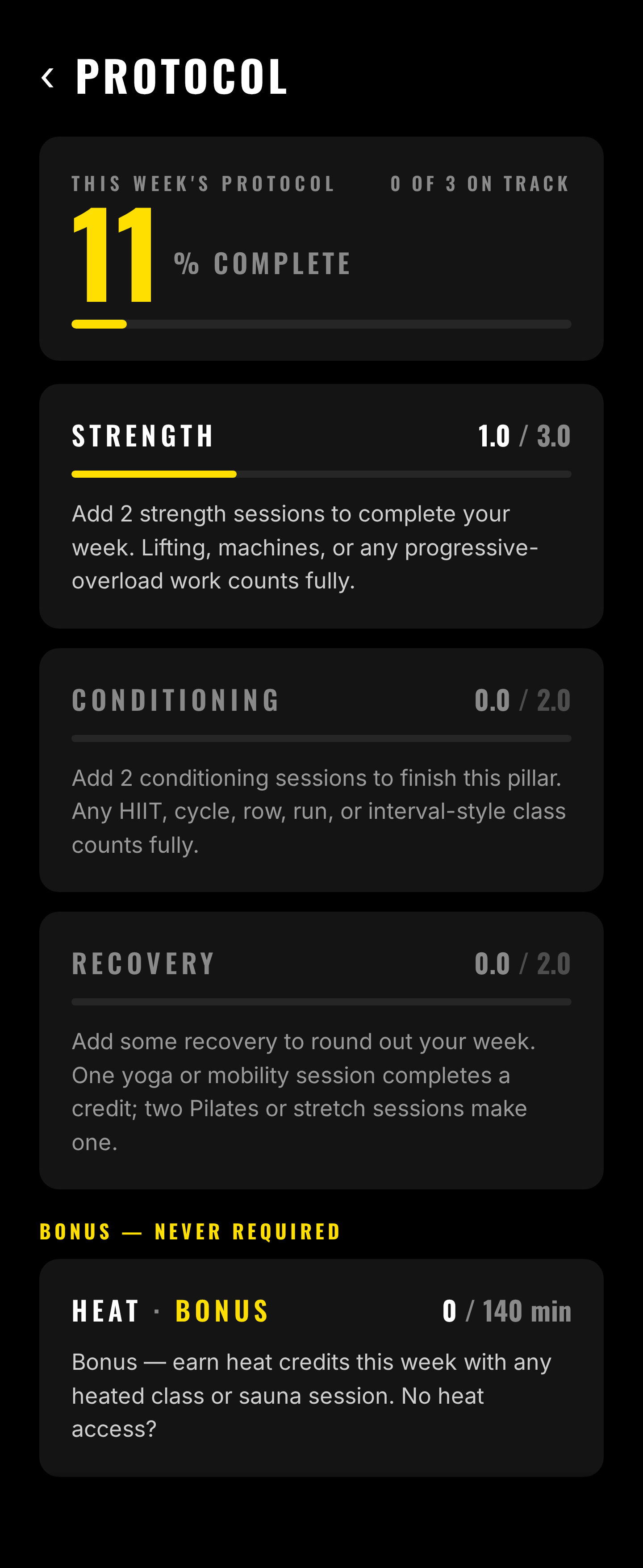
Record completed sets, reps and loads after training. Those entries inform whether the next week's prescription stays at the current load or advances by the progression rule. Your YOURFLO protocol keeps the completed work connected to weekly progress. The screen shown here is the weekly progress view; logging informs what comes next.
The clinician layer // 07
CLINICIANS WHERE THEY BELONG.
Baseline and follow-up testing is ordered and reviewed by licensed clinicians provided through HIPAA-covered clinical partners. The clinician covers the participant's results with them directly.
A CLEAR DIVISION OF ROLES.
- Participant + clinician
- Results interpretation, treatment questions and medication discussions happen directly between the participant and the clinician — never through the employer and never through HI//TRAINING's coaching layer.
- HI//TRAINING
- Training programming, the daily readiness directive, progression structure and adherence. HI//TRAINING does not receive or store clinical records.
- Sponsor
- A cohort-level report, not a roster of individual health or participation information.
Employers and partners receive aggregate, de-identified reporting only — never an individual's health data.
No individual-level information — test results, participation by name, or health data of any kind — is shared with the sponsor. Ever.
Reporting // 08
WHAT YOU'LL SEE AT CLOSE.
A defined cohort deserves a report with defined measures. The dashboard below demonstrates the format, including denominators and incomplete follow-up; it does not show measured program results.
SAMPLE — illustrative data
12-WEEK COHORT / CLOSE-OUT
Example cohort: 100 contracted seats; 90 participants enrolled before week 1. Activity and workouts cover weeks 1–12, with a week-12 activity snapshot. Paired measures use only participants with both baseline and close-out data; the survey is collected at close. Numbers are rounded as shown.
Sample — illustrative
Enrollment & completion
90 enrolled
90 / 100 contracted seats · 90.0% enrolled
Enrollment90%
Completion80%
72 completed / 90 enrolled · 80.0%
Completed the full 12-week pathway and personal close-out. 18 enrolled participants did not meet this definition.
Sample — illustrative
Activity / participation rate
70.0%
63 / 90 enrolled participants active in week 12
Week 1270%
Active means at least one completed training session logged during week 12. This snapshot is distinct from completion across the full pathway.
Sample — illustrative
Workouts completed
24.0 mean / enrollee
2,160 logged completed training sessions / 90 enrollees
Weeks 1–12 combined, including enrollees with zero logged workouts. Equivalent to 2.0 sessions per enrollee per week averaged over the full period; a daily directive is not necessarily a strength workout.
Sample — illustrative
Foundational strength progression
+10.0% mean
60 participants with comparable baseline and close-out records on all three lifts
- Goblet squat+12.0%
- Dumbbell Romanian deadlift+10.0%
- Dumbbell bench press+8.0%
Arithmetic mean of participant-level working-load percentage changes at the same rep and effort target, then equally weighted across the three lifts. No matched records for the other 30 enrollees; this is not a causal effect estimate.
Sample — illustrative
Aggregate testing measure (index)
Baseline100.0Close-out101.0
+1.0 index point · 60 paired records
A generic standardized index used only to illustrate the aggregate-report format: each paired participant's baseline is set to 100, with close-out expressed on that same scale and the means shown. It is not an actual clinical test, specified testing protocol or indication of clinical benefit. The other 30 enrollees have no paired record.
Sample — illustrative
Cohort satisfaction
80.0% favorable
48 / 60 close-out survey respondents
Favorable80%
Favorable = 4 or 5 on a 5-point satisfaction item. Response rate: 60 / 90 enrollees, or 66.7%; 12 respondents rated below 4. Nonrespondents are not assumed to be satisfied.
All values above are synthetic examples, not HI//TRAINING outcomes, benchmarks or forecasts. The illustrative exercise loads in Section 6 describe a separate fictional participant and are not the source of this dashboard. Actual measures, definitions and success criteria are agreed before launch; no individual health data appears in the sponsor's report.
WHAT EACH METRIC COUNTS.
- Enrollment & completion
- Enrollees before week 1 divided by contracted seats; participants completing the full 12-week pathway and personal close-out divided by all enrollees.
- Activity / participation
- Enrollees with at least one logged completed training session during the specified reporting week divided by all enrollees; this sample uses week 12.
- Workouts completed
- Completed training sessions logged during weeks 1–12 divided by all enrollees, including zero-session participants; total sessions are reported alongside the mean.
- Foundational strength
- Mean within-participant percentage change in comparable working load from baseline in week 1 to close-out in week 12, equally weighted across the three named lifts, using the same 60 matched participants.
- Aggregate baseline / close-out measure
- For this sample only, the mean of 60 paired baseline-normalized index values at baseline and week-12 close-out; the generic index carries no clinical interpretation.
- Satisfaction
- Close-out survey respondents selecting 4 or 5 out of 5 divided by all survey respondents, with the response count and respondent-to-enrollee response rate disclosed.
Midpoint, not just the finish
At week 6 you receive a one-page aggregate participation update — enrollment, active participants, sessions completed — so there are no surprises at close.
Small-group suppression
All figures are cohort aggregates. Groups smaller than 20 participants are reported with small-group suppression so no individual can be identified.
No breakdown is shown when its denominator is below 20; complementary small groups are also suppressed where necessary to prevent identification by subtraction.
Implementation // 09
LIVE IN DAYS, NOT QUARTERS.
A defined launch sequence, clear owners and enrollment by code. A cohort can start within two weeks of agreement, with its launch date agreed together.
- Both
Intro call
Confirm fit, cohort size and target start date.
- Both
Agreement and cohort sizing
One agreement, per-participant pricing and success metrics agreed in writing.
- Us
Launch kit delivered
Announcement copy, portal copy, manager talking points and QR poster, all sponsor-branded-ready.
- Sponsor distributes
Enrollment window
Employees enroll with the cohort code; baseline testing is scheduled.
Us administers - Us
The 12 weeks
Daily programming, program communications and a midpoint aggregate update at week 6.
- Both
Close and report
Follow-up testing, aggregate outcomes report and a review call.
There is no integration project, no eligibility-file build, and no IT ticket. Enrollment runs on sponsor-issued codes.
WHAT WE NEED FROM YOU.
- A named sponsor contact.
- Distribution of the launch kit through your normal benefits channels.
- The cohort start date.
That's all. We handle enrollment administration, communications content and reporting.
Pilot program // 10
START WITH ONE COHORT.
12-WEEK PILOT PROGRAM — Start with one defined cohort: success metrics agreed in writing before launch, a full aggregate outcomes report at close, and no obligation beyond the pilot. Pilot cohorts are onboarded on a rolling basis; enrollment per quarter is limited to protect program quality.
Discuss a pilot cohortDEFINED BEFORE DAY ONE.
- Cohort size
- Cohorts run from 100 participants, contracted by seat.
- Success metrics
- Participation rate, program completion, average strength progression and baseline vs. close-out measures, with definitions and denominators agreed in writing before launch.
- Ownership
- One named contact on each side keeps launch decisions and close-out review accountable.
- Pricing
- Pilot pricing is our standard per-participant rate; the pilot's value is its defined scope, not a discount.
- At the close
- A full aggregate report and a review call. Any next cohort or continuity arrangement is an option, not an obligation beyond the pilot.
Pricing posture // 11
PRICED PER PARTICIPANT.
Priced per participant for a defined 12-week cohort. One invoice to the sponsor. No per-employee billing, no consumer subscriptions, no platform fees, no implementation fees.
Pricing is quoted in the intro call against the agreed cohort scope. The sponsor covers the cohort; participants pay nothing to take part.
For scale: a 100-person cohort costs less than one year of GLP-1 medication — at net cost — for three employees.1, 2
CONTINUITY, NOT CLIFFS.
After the 12 weeks, sponsors can keep graduates in the system: alumni continuity (ongoing daily programming at a negotiated continuity rate) or a follow-on challenge cohort — returning participants keep their accounts, baselines, and history. No re-onboarding, no starting over.
Continuity gives sponsors a way to keep the training rhythm available instead of ending access abruptly. Alumni continuity is negotiated and billed to the sponsor, with aggregate reporting continuing. These are optional next steps, not automatic renewals or individual subscriptions.
Privacy & security // 12
BUILT FOR YOUR SECURITY REVIEW.
Plain-language boundaries for the data the training program uses and the reporting the sponsor receives.
Permission-based, read-only access. HI//TRAINING reads wearable and health-app data only with the member's explicit permission, and only the data types the program uses.
Aggregate sponsor reporting. Sponsors receive aggregate, de-identified reporting only, with suppression of groups smaller than 20 participants.
Encryption. Data is encrypted in transit and at rest.
Restricted access. Access to production data is limited to authorized personnel.
Member rights. Members may request export or deletion of their data at any time via hello@getyourflo.app.
Separate clinical responsibilities. Clinical services, including testing and clinician review, are provided by licensed clinicians through HIPAA-covered clinical partners operating under their own compliance programs and business associate agreements.
No sale of personal data. We do not sell personal data.
No advertising use. We do not use member data for advertising.
Evidence // 13
THE EVIDENCE BEHIND THE PROGRAM.
The program's design choices — readiness-guided intensity, progressive overload, systematic variation — are drawn from published research, published in full on our science page.
- Kiviniemi AM, Hautala AJ, Kinnunen H, Tulppo MP. Endurance training guided individually by daily heart rate variability measurements. Eur J Appl Physiol. 2007;101(6):743–751. doi:10.1007/s00421-007-0552-2.
- Plotkin D, et al. Progressive overload without progressing load? The effects of load or repetition progression on muscular adaptations. PeerJ. 2022;10:e14142. doi:10.7717/peerj.14142.
- Kassiano W, et al. Does Varying Resistance Exercises Promote Superior Muscle Hypertrophy and Strength Gains? A Systematic Review. J Strength Cond Res. 2022;36(6):1753–1762. doi:10.1519/JSC.0000000000004258.
- Fonseca RM, et al. Changes in exercises are more effective than in loading schemes to improve muscle strength. J Strength Cond Res. 2014;28(11):3085–3092. doi:10.1519/JSC.0000000000000539.
Citations describe the research behind the design, not a guarantee of results for this cohort or any individual. Trial populations, interventions and measurement methods should be considered when interpreting the studies.
About // 14
WHO'S BEHIND THIS.
HI//TRAINING is built by FLO Group, Inc., part of the FLO ecosystem alongside HI//HOTFLO. Founded by an investment banker at one of North America's largest banks, and the founder of HOTFLO Studios, operating since 2021.
The training system behind HI//TRAINING runs every day in our own studios — the program your employees get is the same system our members train on, delivered through the app.
Comparison // 15
HOW THIS COMPARES.
Compare the core delivery models, not individual vendors. The first two columns describe an education-and-check-in coaching app and a gym-access subsidy; features vary by provider, and a coaching app that also prescribes progressive training is outside that narrow category.
On smaller screens, scroll the table horizontally to compare every column.
| Program feature | Typical coaching app | Gym benefit / fitness subsidy | HI//TRAINING |
|---|---|---|---|
| Prescribed daily training session | No | No | Yes |
| Loads progressed by rule over 12 weeks | No | No | Yes |
| Intensity adjusted to daily readiness | No | No | Yes |
| Clinician-reviewed baseline and follow-up testing | Sometimes | No | Yes |
| Aggregate outcomes report to sponsor | Sometimes | No | Yes |
| Works without a gym | Yes | No | Yes — home dumbbell and bodyweight tracks |
| Participant cost | Varies | Varies | No participant charge — sponsor covers the cohort |
FAQ // 16
QUESTIONS EMPLOYERS ASK.
The practical details, from the first agreement to the options after week 12.
How fast can we launch?
Agreement and cohort sizing can happen in days, and we deliver the launch kit. Employees enroll with sponsor-issued codes, with no integration project. A cohort can start within two weeks of agreement, with the date agreed together.
What do employees need?
A smartphone and a wearable if they have one; readiness also works with manual check-ins. The training tracks use dumbbells or bodyweight only. No gym membership or studio access is required.
What data do we receive?
Aggregate, de-identified reporting only, with small-group suppression for groups smaller than 20 participants. You never receive individual health data, test results or participation by name. The week-6 update covers aggregate enrollment, active participants and sessions completed; the close report includes the defined cohort metrics shown above.
Who are the clinicians?
Licensed clinicians are provided through HIPAA-covered clinical partners. They handle testing review and anything clinical directly with the participant. Results interpretation, treatment questions and medication stay outside the sponsor relationship and HI//TRAINING's coaching layer.
How is it priced?
Per participant for a defined 12-week cohort, with one invoice to the sponsor. There are no platform or implementation fees, and participants pay nothing to take part. Pilots use the standard per-participant rate, quoted in the intro call.
Does this replace our wellness platform?
No — HI//TRAINING runs alongside existing benefits. Enrollment is by sponsor-issued code, so no integration is required. The program adds prescribed training and a defined cohort report rather than requiring a benefits-platform replacement.
What if employees are already on GLP-1 medication?
That is the Companion framing: structured strength training and protein guidance alongside medication obtained elsewhere. It applies whether or not your plan pays for the medication. Medication decisions stay with the employee and their clinician; HI//TRAINING does not prescribe or adjust treatment.
What happens after week 12?
Participants receive their personal close-out summary, and sponsors receive the aggregate report and review call. One option is a follow-on 12-week cohort: returning participants keep their account, baselines and history, so there is no re-onboarding. Another is alumni continuity — ongoing daily programming at a sponsor-negotiated continuity rate, billed to the sponsor, with aggregate reporting continuing. Interested employees can also be routed to studio membership where a location is available; all of these are options, not commitments.
How much work is this for our HR team?
You provide a named contact, distribute the launch kit through your usual benefits channels and join two calls: the intro and close-out review. We handle enrollment administration, communications content and reporting. The cohort start date is agreed together.
Is this a medical program?
No. It is a training and longevity program with a clinician-reviewed testing layer. It does not diagnose or treat any condition, and it does not prescribe medication.
Start the conversation // 17
BRING THE CHALLENGE TO YOUR PEOPLE.
Tell us who you want to support and the approximate size of your cohort. We will use the intro to discuss fit, launch timing, the framing that matches your population and a per-participant quote.
Download the employer one-pager (PDF)
Scheduling link pending. Email hello@getyourflo.app to arrange the intro, or send the inquiry beside this message.
This is a sponsor inquiry, not a clinical intake. Please do not send personal health information or individual test results.
TELL US ABOUT YOUR COHORT.
Required fields are marked “required”. We use these details to respond to your sponsor inquiry. You can also email hello@getyourflo.app directly.